
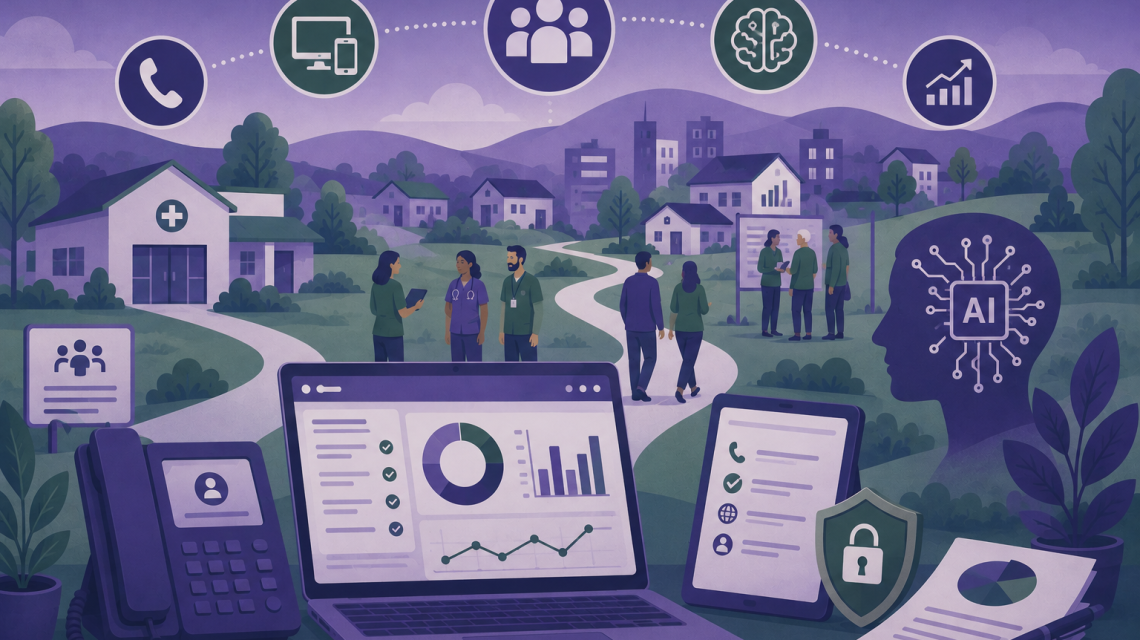
A few things have landed on the desk at once this summer, and for once they point the same way.
The neighbourhood health guidelines for 2025/26 are out. The 2026 GP Patient Survey results are in. Many of us are coming up to the first review point on the cloud telephone systems we were all told to buy eighteen months or so ago. And in the background, quietly, AI has gone from something people argued about to something people are actually using. None of these is dramatic on its own. Together they sketch a fairly clear direction of travel — and the honest question for any practice, and for us at Howbeck, is whether we're moving with it or just watching it go past.
Neighbourhood working. The guidelines make the shape of the next few years plain: neighbourhood teams, care coordinators, shared records, and a lot of emphasis on doing things at a scale bigger than a single practice. What's easy to miss under the language is that the foundation hasn't changed. The "modern general practice model" — access, continuity, a decent experience — is still what everything else sits on. Before anyone gets carried away with dashboards and multidisciplinary teams, the boring questions are still the right ones. Can patients reach us? Do they get to see the right person? The neighbourhood works because the practices in it work. This is exactly the kind of thing a federation is for — the shared plumbing, the agreements, the joined-up view no single practice can build alone.
Analogue to digital. This is the through-line for a lot of what we do. The old copper phone lines are being switched off, which is why we all moved to cloud telephony. The survey shows it's paying back: getting through on the phone is up, using the website is up, the NHS App is up. All good. But "up" still means only around six in ten patients find the phone or the website easy. Four in ten don't. That's a lot of people, and it's the bit worth sitting with. Most practices bought a clever phone system and use about a third of it — call-back switched off on day one, call data never looked at, features the supplier has added since that nobody knows about. The move from analogue to digital isn't finished when the new system is installed. It's finished when you're actually using what you paid for. Same goes for the website and the app: a patient's experience of us begins long before they reach a human.
AI. I'll be honest about where I sit here. I'm not an AI expert. I'm a GP who has spent real time with these tools, got plenty wrong, and found some things that genuinely help. The useful shift this year is that AI has stopped being a party trick and started being a quiet assistant — drafting the letter, summarising the long document, making sense of a spreadsheet nobody had time to read, taking the first pass at the admin so a human can check it rather than start from scratch. It is very good at the first ninety per cent and still needs a person for the last ten. And it needs care: patient-identifiable data doesn't go into just any tool, and governance isn't optional. But used sensibly, it gives time back — and time is the thing we're all short of. (For transparency: I'm also Medical Director at Lexacom, so I have a foot in this world commercially as well as clinically.)
Data that means something. This is the drum I never stop banging. Everyone gets sent data packs. Fewer people read them, and fewer still trust them, because the coding underneath is patchy — and every shiny neighbourhood dashboard is only as good as that coding. Data quality isn't glamorous, but it's the difference between numbers that change what you do and numbers you file. Two live examples. Register cleaning is back in the news, with a recent drive stripping close to 350,000 patients off practice lists nationally — many of them genuine people who then had to re-register while practices picked up the work. Knowing who on your list is genuinely at risk of being wrongly removed is a data job worth doing before a blunt instrument does it for you. And continuity: the evidence that seeing the same clinician over time lowers admissions, and in the strongest studies lowers mortality, is hard to argue with — yet almost no practice can measure its own continuity, because the "usual GP" field is quietly wrong for a big chunk of patients. I built a free tool that checks it, runs entirely in the browser so nothing leaves the practice, and hands back a list to work from. It's on my blog if it's useful: drneilpaul.blog.
So where are we? The front door is getting better but still sticks for too many. The digital kit is bought but half-used. AI is genuinely useful if you're sensible about it. And the data is only as good as the care taken over it. That's the work — and it's the kind of work Howbeck is leaning into. If any of it resonates, come and talk to us.
